
WAR NO MORE?
Towards a pragmatic pacifism

This reflection was originally given as the Dora Turbin Memorial Lecture at a Catholic Peoples Weeks (CPW) gathering in Oxford on 27th October 2007.
Many of the warnings I issued in 2007 are even more relevant today, as we face a rapidly escalating global crisis and a proliferation of violence that requires a radical rethinking of the whole nature of and justification for war. Not only are we experiencing the collapse of the international order, but the violent Christian rhetoric used by American politicians such as President Donald Trump, Vice President J.D. Vance, and self-styled Secretary of War, Pete Hegseth (his official title is Secretary of Defense) is reviving the obscene idea of a Christian holy war.
I anticipated much of this in 2007, when my reference points were the Iraq War and Donald Rumsfeld. Despite seeing the warning signs, I could not have anticipated how rapidly this dystopian future would explode around us.
This talk was written before Ukraine, Gaza, and Iran, before the collapse of American democracy, and before the papacies of Francis and Leo XIV. It does, however, speak to all those situations. I have lightly edited and shortened it, added some updates in italics and included some video links, but most of it remains unchanged.
This video provides an excellent context within which the following should be read today:
The Dora Turbin Memorial Lecture - October 2007
War is one of the most complex ethical dilemmas faced by humankind, and it becomes more rather than less complex in our modern world with proliferating military technology and state power on the one hand, and proliferating tyranny, violence and anarchy on the other. I called this paper ‘War No More?’, but there is a question mark in the title because I am aware of how easy it is to promote pacifism when one has never been directly threatened with the kind of violence that many have faced in our own lifetimes.
This is especially pertinent with regard to Ukraine’s war of self-defence against Russian aggression.
There are three broad approaches to the waging of war in modern political debate: realism, just war theory, and pacifism. ‘Realism’ refers to the belief that war is beyond morality, and the waging of war must be done by any means available to ensure rapid and decisive victory. This idea is associated with Carl von Clausewitz (1780-1831), who described war as ‘the continuation of politics by different means.’ This is the attitude adopted by some American neo-cons such as Donald Rumsfeld, in their strategy of ‘shock and awe’ with regard to the attack on Iraq. However, such an approach flies in the face of many criteria of just war theory and has never found sanction in Catholic teaching.
The catastrophe of the Iraq war, the agonisingly drawn out and ultimately futile occupation of Afghanistan, the genocidal destruction of Gaza, and now the chaos unleashed in Iran and surrounding areas, do not even have the benefit of rapid and decisive victory. This is not realism but a savage fantasy of domination, when murdered and orphaned children have no more significance than avatars in a video game.
The conflict between pacifism and just war theory has been described as a conflict between peace and justice. Some argue that a non-violent ethos, even if it means tolerating injustice, is better than violent resistance to injustice. Others argue that justice makes a more primal claim upon us than peace at any cost, and in some situations, we are obliged to resist injustice with force if necessary.
With these complexities in mind, I want to put forward an argument in favour pragmatic pacifism – a term I shall explain later – but I do so from a position of tentative enquiry rather than ideological certitude. The older I get, the more afraid I am of people who take up positions unassailed by doubt or by the acknowledgement that they may be profoundly wrong. So the ideas I explore here are not a manifesto but a series of suggestions that are open to discussion and debate.
When we address questions of war and violence, we do so in particular historical and cultural contexts that shape our reflections. What are the contexts in which we must situate our reflections today? First, there is the long legacy of the Christian tradition and its evolving attitudes to war. Second, there is the dramatic change in the nature and scale of warfare during the last hundred years. Third, there is the influential argument by many atheists that religion is the root cause of war and violence in our world. Fourth, there is the quest for a more creative solution to the problem of war, violence, and international politics than those currently available to us. I address each of these in turn: the historical legacy of Christianity, the nature of modern warfare, the challenge posed by atheism to Christianity as regards war and violence, and finally some suggestions as to what might constitute responsible and faithful citizenship with a commitment to non-violence in the times and places of our own historical existence.
The Historical Legacy
There are scholarly debates over the exact nature and extent of pacifism in the early Church, but it seems highly probable that, for the first three centuries, Christianity was largely pacifist in its teachings and practices.1 The surviving literature suggests that soldiers who were baptised were expected to give up serving in the Roman army. The Canon of Hippolytus, dating from around the fourth century, includes the following instruction:
Let a Christian not become a soldier. A Christian must not become a soldier, unless he is constrained by a chief who has a sword. Let him not take on himself the sin of blood. But if he has shed blood, let him not take part in the mysteries, unless he has been purified by a punishment, by tears and groans. Let him not exercise his command with duplicity but with the fear of God.2
I have referred to ‘pragmatic pacifism’, and I’d draw attention to the pragmatism in this teaching. It does not place an impossible burden upon the person who might be compelled to fight, but it does insist that the shedding of blood is a sin that requires penance. This attitude prevailed in the Christian Church until it was overtaken by the idea of the holy war in the Middle Ages. One reason why there are so many side chapels in medieval cathedrals is because a veritable Mass industry was fuelled by soldiers returning from war, having to undergo penance before they could be fully reintegrated into the worshipping community. War bore the taint of violence, and those who engaged in it were inevitably implicated in its sinfulness.
The shift from early pacifism to just war theory was a gradual process, but it was Augustine (354-430) who, faced with the collapse of the Roman empire and the conflicts that followed, introduced the concept of the just war into the Christian tradition.3 In setting out the criteria that might justify war, Augustine argued that, subject to rigorous terms of engagement designed to minimise the impact and lasting effects of violence, war was sometimes necessary to defend the innocent and preserve peace. I quote:
We do not seek peace in order to be at war, but we go to war that we may have peace. Be peaceful, therefore, in warring, so that you may vanquish those whom you war against, and bring them to the prosperity of peace.4
Like other early Christian thinkers, Augustine saw war as evidence of the power of sin over human relationships and therefore as deeply problematic for all those involved. It is more accurate in Augustinian terms to speak of a justified war rather than a just war.5 Nevertheless, the language of the Christian faith has been informed by warlike imagery, initially used by early pacifist Christians as a rhetoric of resistance to the violence of the Roman Empire. Tertullian, writing in the third century, declared that
The divine banner and the human banner do not go together, nor the standard of Christ and the standard of the Devil. Only without the sword can the Christian wage war: the Lord has abolished the sword.6
It is relevant here to note Pope Leo’s latest (at the time of writing) tweet:
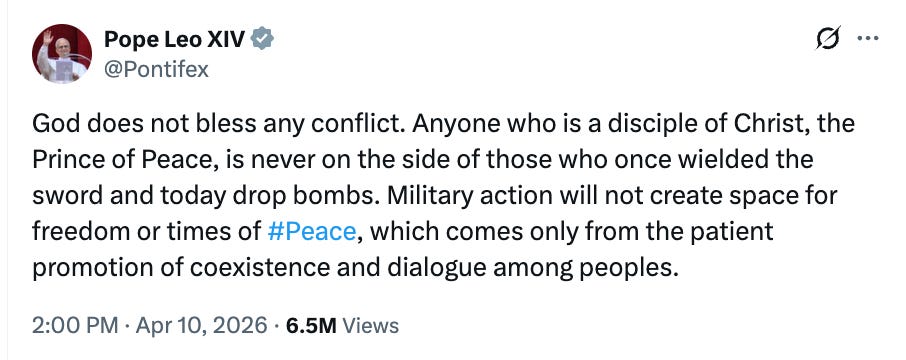
The idea that Christians were involved in a war of peace against the bloodshed of imperial politics permitted the flamboyant use of militaristic language, but when Christians themselves became the political leaders of the Western world, this bellicose rhetoric took on an altogether different flavour. One cannot easily sing ‘Onward Christian soldiers’ while Christians are bombing and shooting their fellow human beings in the name of states, empires and political expediency.
Writing under different historical and social conditions in which Christianity occupied a more secure position, Thomas Aquinas (c.1225-1274) lacked the more pessimistic aspects of Augustine’s thought. In his synthesis of Augustinian theology and Aristotelian philosophy, he introduced self-defence as a justification for war. (Augustine had believed that Christians should not fight in self-defence but only in defence of an innocent third party, as an act of neighbourly love). Aquinas’s just war theory continues to shape Western political and ethical debate. In its classical formulation, the theory is divided into rules that govern the resort to war (jus ad bellum) and rules that govern the waging of war (jus in bello). The latter usually include criteria of proportionality and discrimination – the means used to wage war must be proportionate to the threat, and there must be no intentional targeting of non-combatants. The former are well-summarized in the excellent 1984 pastoral letter by the American bishops, ‘The Challenge of Peace’. The following is taken from a condensed version of that letter:
Just cause. War is permissible only to confront “a real and certain danger,” i.e., to protect innocent life, to preserve conditions necessary for decent human existence and to secure basic human rights.
Competent authority. War must be declared by those with responsibility for public order, not by private groups or individuals.
Comparative justice. In essence: Which side is sufficiently “right” in a dispute, and are the values at stake critical enough to override the presumption against war? Do the rights and values involved justify killing? Given techniques of propaganda and the ease with which nations and individuals either assume or delude themselves into believing that God or right is clearly on their side, the test of comparative justice may be extremely difficult to apply.
Right intention. War can be legitimately intended only for the reasons set forth above as a just cause.
Last resort. For resort to war to be justified, all peaceful alternatives must have been exhausted.
Probability of success. This is a difficult criterion to apply, but its purpose is to prevent irrational resort to force or hopeless resistance when the outcome of either will clearly be disproportionate or futile.
Proportionality. This means that the damage to be inflicted and the costs incurred by war must be proportionate to the good expected by taking up arms.
These criteria informed Christian just war theory, and they continued to shape the politics of war and debates about its legitimacy long after Christianity had lost its influence over the public sphere of Western politics, at least outside the United States.
The idea of the holy war that prevailed during the Crusades transformed the fighting of war from an undesirable but sometimes necessary duty, to a virtuous activity for Christians. The idea of the holy war remains deeply seductive to some Christians, not least in the attitude of some Americans to their country’s war in Iraq, but I think it is safe to say that few mainstream Christians today would defend such an idea.
President George W. Bush aroused concern among liberals when he referred to ‘the war on terrorism’ as a crusade, in a talk on 16th September 2001 that was redolent with allusions to Christian America fighting evil. The idea of the holy war was seeded anew in American politics after 9/11, and today its bitter fruits are being reaped in Far Right movements in the UK and the rest of Europe as well, where Christianity is being claimed by Far Right nationalists and white supremacists.
The Modern Papacy and War
The Catholic Church has been a prophetic voice in the promotion of international law and non-violent forms of conflict resolution as an alternative to war in the modern world. The 1964 encyclical, Pacem in Terris, makes no reference to just war theory. Written at the height of the Cold War, it remains a startling document to read for its vision of a new world order based on the primacy of human rights, the authority of international law, and the rejection of war and militarism. Populorum Progressio¸ written in 1967, is also implicitly but unambiguously written from a position that eschews war in favour of alternative ways of pursuing justice. Pope John Paul II, a man whose life was profoundly shaped by the violence of the twentieth century, from his early experience of the Nazi occupation of Poland to his later experience of communism, spoke out passionately and repeatedly against the evil of war. Although not a pacifist, it was clear that he saw a fundamental conflict between the demands of humanitarianism and the realities of war.
Benedict XVI continued this trend of distancing the Church from the politics of war. After the 9/11 attack on America, there was a campaign by some conservative American Catholic theologians, most notably George Weigel and Michael Novak, to have the just war criteria extended to include the legitimacy of a pre-emptive strike. This might have justified the attack on Iraq by America and Britain – though whether it would have satisfied the demands of proportionality, minimum force and legitimate authority would still be debatable. Despite strenuous overtures to Rome by Weigel and Novak, both John Paul II and the then Cardinal Ratzinger resisted their demands. Responding to their petitions, Cardinal Ratzinger argued that
There were not sufficient reasons to unleash a war against Iraq. To say nothing of the fact that, given the new weapons that make possible destructions that go beyond the combatant groups, today we should be asking ourselves if it is still licit to admit the very existence of a ‘just war’.
We should not under-estimate how potentially radical this question is, when asked by the leaders of the Catholic Church. Michael Walzer, in his book Just and Unjust Wars, makes the point that bishops have always declared their own countries’ wars just, so that in the Second World War, both Germany and Britain fought with the blessing of their bishops. But for the first time since the conversion of Rome, western nations now go to war without the sanction of their church’s leaders.
Pope Francis continued to develop a doctrine of non-violence, bringing the Church ever closer to pacifism, but it is in Pope Leo XIV’s recent condemnations of American aggression in the Middle East that the Catholic Church is coming close to a radical confrontation between the militarism of global politics and the politics of peace preached by the Church. For example, after Donald Trump was photographed being prayed over by evangelicals in the Oval Office, the Pope said this in his homily at the Palm Sunday Mass:
Brothers and sisters, this is our God: Jesus, King of Peace, who rejects war, whom no one can use to justify war. He does not listen to the prayers of those who wage war, but rejects them, saying: “Even though you make many prayers, I will not listen: your hands are full of blood” (Is 1:15).
The Nature of Modern Warfare
I am sure I do not need to point out how destructive and indiscriminate the waging of war has become in the modern world, but let me give a few statistics from a compilation of sources from worldrevolution.org.
[Note: what follows was written in 2007. The statistics would be worse today].
In the last ninety years, three times more people have been killed in war than in the last five hundred years, making the twentieth and early twenty first centuries the bloodiest and most brutal era in history. Since the end of the Second World War, more than 250 major wars have left over 23 million dead, many more millions homeless, and such conflicts continue to fuel a growing refugee crisis. In the 1990s alone, more than 50 million people had to flee their homes as a consequence of war and armed conflict. There are now more than 500 million small arms and light weapons in global circulation, and 46 out of 49 conflicts since 1990 have been primarily fuelled by small arms. Four million have so far died in these conflicts, about 90 percent of whom are civilians, and 80 percent women and children. In fact, one of the most shocking realities of the last century has been the changing demographics of war. In the First World War, 10 percent of casualties were civilians. In the Second World War, that figure rose to 50 percent. Today, it’s closer to 90 percent, and three out of four fatalities are women and children. In the past decade alone, an estimated two million children have been killed in armed conflict – more children have died than soldiers in recent wars. That alone utterly invalidates any Christian appeal to just war criteria, for when innocent people die on that scale, there can be no question of fine points of intentionality. Any war that kills a higher proportion of civilians than combatants has lost the battle for the moral high ground.
Against this backdrop of evil (I rarely use that word, but I use it very deliberately here), is the predatorial culture of the corporate arms trade – a cannibalistic Mammon with an insatiable greed that makes a mockery of our western democratic and ostensibly egalitarian political systems. Those of us who hoped that the end of the Cold War would see the end of nuclear proliferation watch in shame and horror today as the spectre of annihilation looms before us again. But even setting aside nuclear war, the sheer scale of spending on war in a world in which children starve and our fellow human beings lack access to the most fundamental human necessities of clean water, adequate health care and basic education is an outrage. Current global military expenditure exceeds the total income of the poorest 45% of the world’s people. What kind of long-term stability might we bring to our world if we used our resources in a war against poverty rather than a war against terrorism? Why is it that it takes decades to realise political promises to improve our basic social facilities, while we can organise and finance a major war in three months?
So, we stand on the far side of a very dark century, and the beginning of the twenty first century suggests that things might get worse before they get better. [I was right!] But even as we accumulate ever more deadly military technology, the enemies we seek to defend ourselves against become more and more elusive and less and less vulnerable to the kind of military hardware being developed. Nuclear weapons and new generations of bombers and missiles will not protect us from people desperate enough or fanatical enough to fly aeroplanes into buildings or to blow themselves up in tube trains. When the human body itself becomes a weapon of war, then we have no choice but to radically change the ways in which we tackle the problem of violence, perhaps by beginning to ask why a growing number of human beings are driven to such extremes by the conditions and conflicts of modernity.
Today I would add drone warfare and virtual wars waged through the disruption and weaponisation of the worldwide web.
I want to turn now to the third aspect of the context in which we find ourselves – the popularity of the movement known as the new atheism, spearheaded by Richard Dawkins and Christopher Hitchens, which bases its case on two central claims – 1) that modern science has made it irrational to continue to believe in God, and 2) that religion is the primary cause of war and violence in our world.
Religion, War and Militant Atheism
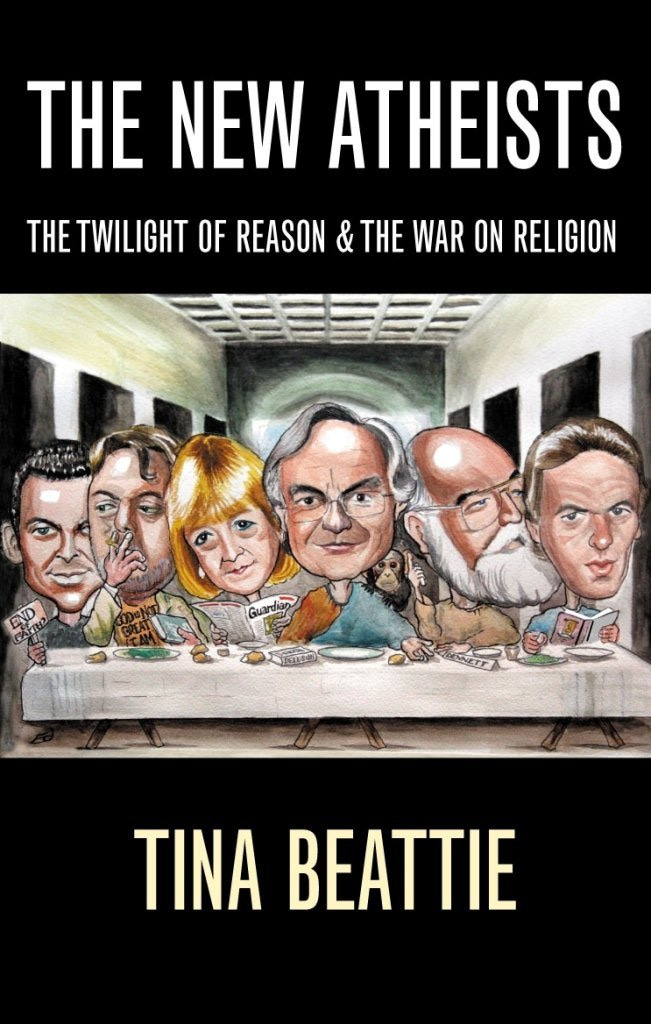
If one reads the bestsellers by the so-called new atheists, one comes across the argument again and again that religion is the primary cause of violence in our world. In his 2007 polemic God Is Not Great: How Religion Poisons Everything, Christopher Hitchens writes,
As I write these words, and as you read them, people of faith are in their different ways planning your and my destruction, and the destruction of all the hard-won human attainments that I have touched upon. Religion poisons everything.
In The God Delusion (2006), Richard Dawkins invites us to
Imagine, with John Lennon, a world with no religion. Imagine no suicide bombers, no 9/11, no 7/7, no Crusades, no witch-hunts, no Gunpowder Plot, no Indian partition, no Israeli/Palestinian wars, no Serb/Croat/Muslim massacres, no persecution of Jews as “Christ-killers”, no Northern Ireland “troubles” ...
This idea that religion causes war has caught the imagination of the liberal intelligentsia in Britain, so that there is often little attempt to bring any political or historical analysis to bear on the kind of conflicts to which Dawkins refers – they are all, purely and simply, religious wars.
But let’s remind ourselves that the death tolls of the twentieth century constitute an unimaginably dark legacy of an era in which for the first time in history large numbers of political regimes shrugged off their religious traditions and values, in order to experiment with a range of post-religious ideologies and political utopias. Stalinism claimed somewhere between 9 and 60 million victims, Hitler’s regime murdered as many as 15.5 million people, including 6 million Jews, and Maoism killed an estimated 30-40 million. If we add to these the total death tolls of the First World War (15 million) and the Second World War (50-55 million), and we bear in mind that many of these deaths occurred in the heart of Europe in the aftermath of the nineteenth century triumph of science and reason over religion and superstition, we should surely be sceptical of those scientific rationalists who continue to blame religion for most of the violence in the world?
In 2004, the BBC commissioned the Department of Peace Studies at the University of Bradford to conduct a ‘War Audit’ for its programme titled ‘What the World Thinks of God’. The authors of the War Audit noted that, ‘Atheistic totalitarian states ... have perpetrated more mass murder than any state dominated by a religious faith.’
They refer to ‘the over-simplifications that have crept into media reporting about the prominence that war occupies in one religion or another.’ In seeking to offer a more informed perspective, they compiled two tables – one showing major wars in the three and a half thousand years up to the end of the nineteenth century, and the second showing major wars of the twentieth century. In each case, they evaluated the significance of religious ideas and justifications in relation to the wars being fought, based on five criteria:
religion as a mobiliser
religious motivation and discourse by political leaders
attacks on symbolic religious targets
conversion goals
strong support from religious leaders
Wars that had a clear religious motivation included the Arab conquests (632-732), the Crusades (1097-1291), and the Reformation wars of the sixteenth and seventeenth centuries. However, they found that religion was not a motivating factor in any of the major wars of the twentieth century. With regard to the conflicts of the early twenty first century, the audit sees the same trend – namely, that ‘what many represent as religious wars have more convincing explanations as manifestations of policies, not religion, and that religion is more likely to be a cause of war when religion and the state authorities become closely allied or intertwined.’
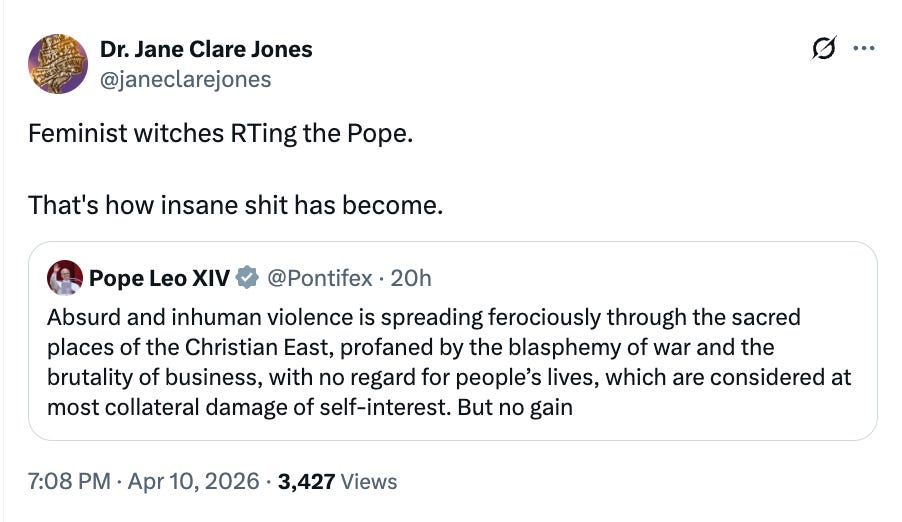
Today, these comments might need more nuance, given that Christianity is being coopted in the name of violence, as populism and the Far Right become more influential in Western politics. The papacy is however emerging as the most consistent anti-war voice in modern times, and in the last few weeks Pope Leo has attracted widespread admiration from far outside the Catholic Church:
In order to counter the violence of our times, those of us who see peace-building as a viable alternative need to be as committed and dedicated in our pursuit of peace as our governments are in their pursuit of war, and that brings me to the final part of this paper.
Pragmatic Pacifism
I resist the arguments of those who would offer an absolutist version of Christian pacifism, and also those of some Christian theologians such as Stanley Hauerwas and John Milbank, who see the modern nation state as inherently violent, while often underplaying the violence of Christian history. If Christianity really does nurture non-violence, I should like to see the historical evidence that this has ever been an enduring trend. Certainly, there is a long and noble tradition of non-violence stretching from the Church Fathers through Francis of Assisi to modern prophets such as Martin Luther King and Dorothy Day, but this has always been more of an individual or minority trend than a general movement within Christianity.
But the Catholic doctrine of grace and natural law does not allow us to see the state as inherently violent or Christianity as essentially pacifist. That brings us close to a kind of Manichean dualism that has no place in the Catholic tradition. This is why I speak of a pragmatic rather than an absolute pacifism. A pragmatic pacifism does not retrospectively pass judgement on the wars of history, nor does it condemn those who, for whatever reason, are unable to abstain from military service. However, in a pragmatically pacifist church, our remembrance services and our attitudes towards Christians engaged in war would always be penitential, mourning victims on all sides, and there could be no room for any whisper of triumphalism or heroism. Nor should there ever be national flags in Christian churches. War is the most dark and shameful face of the human condition, and it should be portrayed as such in every church.
There is another point I want to make. Whenever one mentions pacifism, somebody inevitably asks. ‘What about Hitler?’ There are two possible responses to this. First, in that particular historical context, war may well have been an unavoidable and tragic necessity, but that does not sanction today’s wars, which are fought under quite different conditions and by vastly different means. Second, why begin with Hitler? Nazi Germany was in itself a product of war’s legacy, for the poverty and shame of the German people in the 1930s created the conditions for the rise of Nazism. So we can have an infinite regress. What about Hitler? Well, if the Church had always been pacifist, the First World War might not have happened, and then the conditions may not have been there for Hitler to acquire such power. In other words, these arguments do not get us very far, and there must be a point when a generation has the courage to say ‘enough’, even though we cannot and should not try to offer a neat solution to all the problems and complexities of the issues.
I am suggesting that we are that generation, because even if we maintain a hypothetical concept of a just or at least a justified war, the economics, technology, methods and motives that drive the modern war machine have created an irreconcilable conflict between war and Christian values. But we still must address the challenge of violence, tyranny and aggression – I am not advocating a form of passive martyrdom in the face of evil, though we should not under-estimate the power of such acts. But in general, we have a moral responsibility to our fellow human beings and to the state to defend those values that allow us to cohabit in that kind of peace that is more than the absence of war, for it is a peace suffused by justice and by conditions that sustain human flourishing.
Promoting Peace, Disgracing War
So let me suggest some strategies for discussion. First, Catholic institutions should be far more proactive in promoting the Church’s opposition to modern war, in catechesis, schools and pastoral formation. For example, we might ask if the military should ever be allowed access to Catholic schools for the purposes of recruitment. This is particularly pertinent today, given that widespread disillusionment and trauma regarding the experience of the armed forces in Iraq and Afghanistan has created a recruitment crisis. A Plaid Cwmru study reported that poor schools were much more likely to receive repeated recruitment drives than those in richer areas.
This is still the case, as reported in 2018:
British military recruiters are targeting working-class young people who like risk, are easily influenced and are poor at money management, a briefing document for a glossy army advertising campaign suggests.
The document for the army’s This Is Belonging campaign also highlights a drive to recruit young people in cities in northern England and to grab the attention of possible recruits in places such as gyms, pubs and cinemas.
We might also ask if any Catholic can in good conscience work for the arms trade and its related industries. If Catholic doctors and nurses are asked refrain from working in any contexts that involve abortion, often at considerable cost to their careers and prospects of promotion, should Catholics not also refrain from working in the war industry?
Allied to this resistance to the war-making activities of the modern nation state, should be a commitment to the United Nations and international law as the proper channels for peace-keeping in the modern world. To make the UN an effective peace-keeping force such as seemed possible for a brief moment in the early 1990s, entails the recruitment of disciplined members of the armed forces who would carry arms only for the purposes of self-defence and for protecting the innocent. So, in Rwanda, there would have been no question of the need to use force to deter those bent on genocide. I am suggesting that there is a strong case to be made for Christians joining the armed forces and offering to serve in such peace-keeping roles. There is a huge difference between aiming a gun at an aggressor to defend an innocent third party or in self-defence, and dropping bombs and missiles on urban populations in a way that seeks to ensure the invincibility of the soldier, even if this means killing large numbers of ordinary people. That is why I see the armed peace-keeping force as a viable alternative to the technologically devastating military power of the nation state. The just war criteria can apply in defensive peace-keeping activities even if they can no longer apply in warfare per se. Hand in hand with this would go a clear commitment for Catholics who join the armed forces to work only in non-combatant roles, as chaplains already do. Such a non-violent presence in situations of war might be far more eloquent than total absence from war.
Much of the foregoing is still relevant, though the United Nations has ceased to be any kind of unifying and effective body for the promotion of peace and international law. We are entering an era of global anarchy, in which perhaps only the Catholic Church has the international influence to be a voice for peace.
We might also campaign for the development of effective technologies and education programmes aimed at civil resistance movements and at defensive strategies that would deter aggressors but stop short of war. In fact, one of the most potent and hopeful signs of the late twentieth century was the toppling of two of that century’s most abhorrent regimes – the Soviet Union and apartheid South Africa – through peaceful protest and human solidarity.
I wrote that before Russia became the global threat it is today, with the complicity of the United States.
Of course, we are never going to eliminate war, and the kind of strategies I am proposing would not avoid bloodshed, conflict and failure. But we have to balance against this the vastly destructive power of war itself. It is hard to imagine any peace-keeping effort, however bungled or clumsy, creating the kind of devastation that we have created in Iraq.
To this I would add Afghanistan, Gaza, Iran, and the looming prospect of World War III.
Ultimately, I am convinced that the example of Christ poses an inescapable challenge. Christians are sometimes called to die for our beliefs, but we should never be willing to kill for them. People are worth dying for, but ideas are never worth killing for.
I referred earlier to the rhetoric of warfare that informed early Christian pacifism. I want to end by reclaiming that rhetoric, with a quotation from one of the twentieth century’s greatest advocates of non-violence. Martin Luther King said,
Nonviolence is a powerful and just weapon, which cuts without wounding and ennobles the person who wields it. It is a sword that heals.
For a good overview of these different debates, see ‘Christian Pacifism: Early Christian Views of War’, Crusades Encyclopedia at http://www.crusades-encyclopedia.com/christianpacifism.html. One of the most widely cited sources is the essay by Roland H. Bainton, ‘The Early Church and War’, The Harvard Theological Review, Vol. 39.3 (July 1946), pp. 189-212. For more recent sources, see Peter Brock, Varieties of Pacifism: A Survey from Antiquity to the Outset of the Twentieth Century (Toronto: University of Toronto Press, 1998); Lisa Sowle Cahill, Love Your Enemies: Discipleship, Pacifism, and Just War Theory (Minneapolis: Fortress Press, 1994); L.J. Switt, The Early Fathers on War and Military Service. Message of the Fathers of the Church, Vol. 19 (Wilmington DE: Glazier, 1983).
Quoted in Jean-Michel Hornus, It Is Not Lawful for Me to Fight: Early Christian Attitudes Toward War, Violence and the State, trans. A. Kreider and O. Coburn (Scottdale Pennsylvania: Herald Press, 1980), p. 167.
For the just war tradition, see Jean Bethke Elshtain (ed.) Just War Theory (Oxford: Basil Blackwell, 1992); Oliver O’Donovan, The Just War Revisited (Cambridge: Cambridge University Press, 2003; Gregory M. Reichbert, Henrik Syse and Endre Begby (eds), The Ethics of War: Classic and Contemporary Readings (Oxford: Blackwell Publishing, 2006); Michael Walzer, Just and Unjust Wars: a Moral Argument with Historical Illustrations, 2nd edn. (New York: Basic Books, 1992).
Augustine, Ep. ad Bonif. clxxxix, quoted in Micheline R. Ishay, The Human Rights Reader: Major Political Essays, Speeches, and Documents from the Bible to the Present (London and New York: Routledge, 1997), p. 61.
For more on this, see Roger Ruston, ‘The War of Religions and the Religions of War’ in Brian Wicker (ed.), Studying War No More – From Just War to Just Peace (Kampen: Kok Pharos, 1993; Grand Rapids: Eerdmans, 1994), pp. 13-31.
Tertullian, On Idolatry 19; On the Chaplet 11-12, quoted in Eberhard Arnold, The Early Christians In Their Own Words, reprinted from www.bruderhof.com, copyright 2003 by The Bruderhof Foundation, available as an e-book at http://www.plough.com/ebooks/pdfs/EarlyChristians.pdf, p. 268.
“Woe to me!” I cried. “I am ruined! For I am a man of unclean lips, and I live among a people of unclean lips, and my eyes have seen the King, the Lord Almighty.” Isaiah 6:5
It’s taken me more than a couple reads and days to think and understand the research, history and Faith perspective in this profound essay, War No More. Recent American wars are becoming more repetitive and not accomplishing their murky goals. Civilian death tolls are seldom mentioned in the news we receive and it’s hard to find any unbiased approach with the political camps yelling their partisan rants.
Pragmatic pacifism is an understandable place to stand in the complexities of our time. It takes you beyond binary choices to how can I respond to global conflict in my small area of influence. I’m glad to at least have a starting point of view that I can own and learn how to use.
Isaiah’s, Woe is me, was his reaction to a vision of God’s holiness in his time of conflict. For me, recalling this is a wake up call in this time.